Filling Tests for Features under Development
Requirements
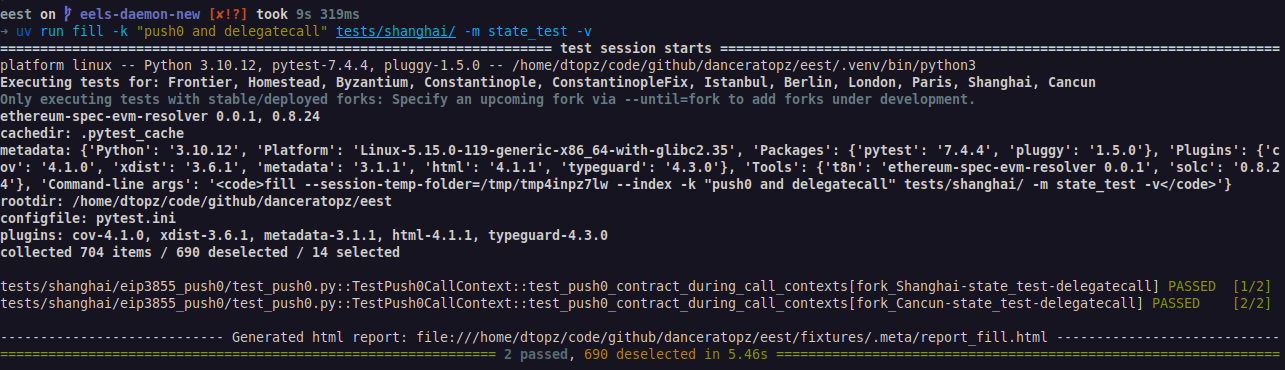
By default, the execution-testing framework only generates fixtures for forks that have been deployed to mainnet. In order to generate fixtures for evm features that are actively under development:
- A version of the
evmandsolctools that implement the feature must be available (although, typically only a developer version of theevmtool is required, usually the latest stable release ofsolcis adequate), and, -
The development fork to test must be explicitly specified on the command-line:
uv run fill -k 4844 --fork=Cancun -vuv run fill -k 4844 --from=Cancun -vuv run fill -k 4844 --until=Cancun -v
Specifying the evm binary via evm-bin
It is possible to explicitly specify the evm binary used to generate fixtures via the --evm-bin flag, for example,
uv run fill --fork=Cancun --evm-bin=/opt/bin/evm -v
Synthetic blob schedules
Every fork from Amsterdam on gets two blob parameter only (BPO) scenario forks, generated in forks.py, so a new fork or a new BPO fork needs no extra work:
<Fork>BPOIncreaseraises the target of<Fork>by half.<Fork>BPODecreaselowers the target of<Fork>to two thirds.
Both keep the max to target ratio of <Fork>, rounded up, and scale the update fraction with the target, as on mainnet, so the blob base fee falls at the same rate per empty block. They run under the rules of <Fork>. For Amsterdam the increase is 21/32 with update fraction 17527006 and the decrease is 9/14 with update fraction 7511574. These are test scenarios, not scheduled network upgrades.
Both scenarios follow <Fork> directly and take the next client BPO slot after the BPO forks it descends from, so the Amsterdam scenarios both fill HIVE_BPO3_*. The transitions into them activate at timestamp 15,000 and leave out the repeated fork name, for example AmsterdamToBPOIncreaseAtTime15k and AmsterdamToBPODecreaseAtTime15k. Hive already maps the numbered keys onto the client config, so a new fork or BPO fork needs no Hive change either, as long as the slot stays within the BPO slots Hive maps (currently up to HIVE_BPO5_*).
A fork range fills the scenarios of every fork it selects, together with the transitions into them, so releases, devnets and CI include them with no extra option. For example, --until=Amsterdam fills AmsterdamBPOIncrease, AmsterdamBPODecrease and both transitions. --fork=Amsterdam fills Amsterdam alone; select a scenario on its own with --fork=AmsterdamBPODecrease.
uv run fill tests/osaka/eip7918_blob_reserve_price/ --from=Amsterdam --until=Amsterdam
Once a fork is deployed, a plain fill also fills its scenarios. --until=AmsterdamBPODecrease selects Amsterdam, so it fills both of Amsterdam's scenarios. --until=Amsterdam still excludes the historical parallel BPO3–BPO5 branch. Numbered fork and transition definitions remain available for older fixtures and genesis files.
Clients must permit their BPO slots to activate after the fork the scenarios follow. Successful filling does not establish client compatibility.
On BPO forks, including these scenarios, only the tests marked with valid_for_bpo_forks run. Each BPO fork repeats them, so a test that varies blob counts should only use the counts at the edges of a BPO fork's schedule; SpecHelpers.get_blob_counts in tests/cancun/eip4844_blobs/spec.py returns those.
Further Help
Verifying evm and solc versions used
The versions used to generate fixtures are displayed in the console output: